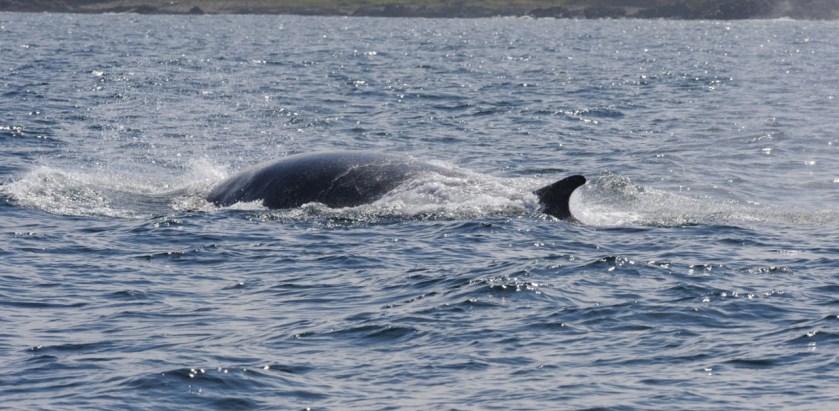
A paper from my lab, led by Betty Boyse as part of her PhD work, shows how tiny traces of DNA from seawater can provide crucial information about the relationship between marine mammals and key prey species to support their conservation.
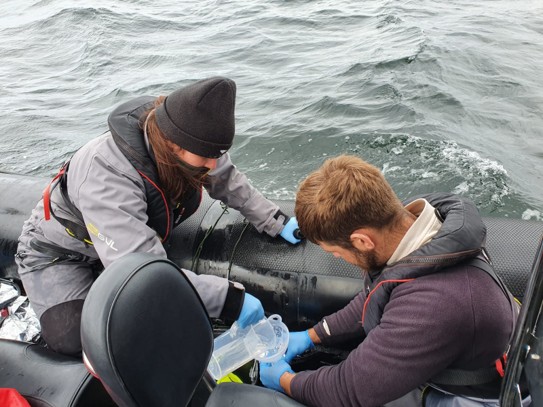
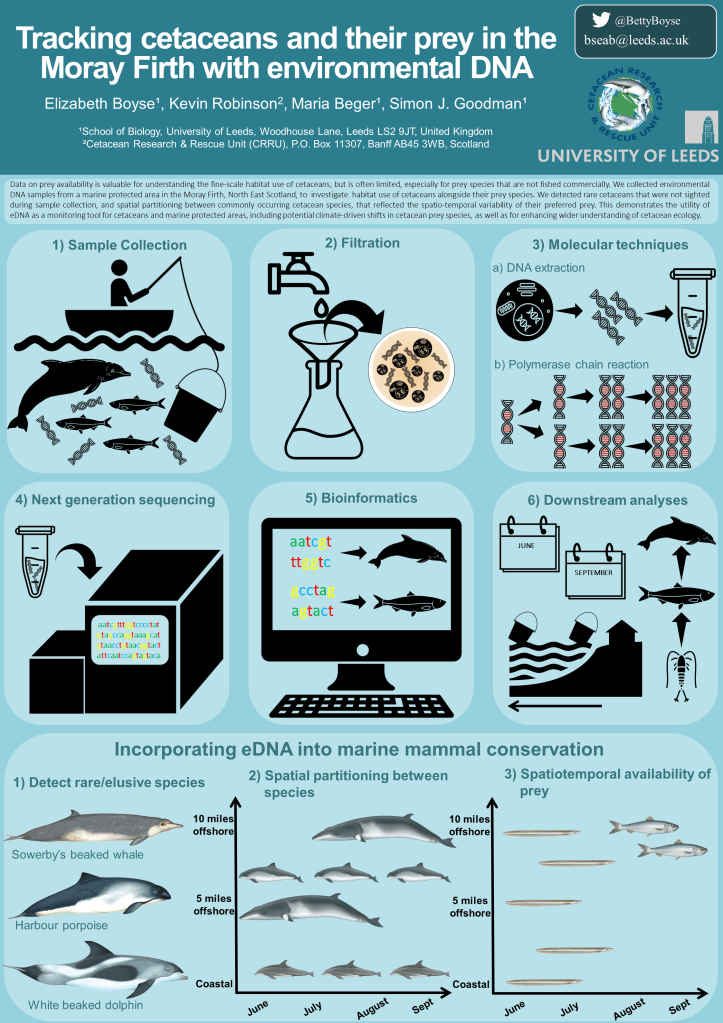
Our team from the University of Leeds, University of Milano-Bicocca, and the Cetacean Research and Rescue Unit NGO, used the traces of DNA left by animals in seawater (environmental DNA (eDNA)) to follow the seasonal movements of minke whales, bottlenose dolphins and harbour porpoises, along with their prey species in the newly created Southern Trench Marine Protected Area off the coast of northeast Scotland.
This is one of the first times the approach has been used successfully to detect patterns between whales, dolphins, and their prey, and shows the potential of the technique to help guide and monitor marine conservation efforts.
We also found evidence for the presence of Atlantic blue fin tuna and the critically endangered European eel amongst many other marine species of conservation interest.
“Marine protected areas are vital for conservation, but they are often too small and disjointed to provide adequate protection for far-ranging marine mammals with complex seasonal foraging and breeding behaviours, which are sensitive to environmental change,” said Dr Elizabeth Boyse, lead author of this study, who did the work as part of her PhD at the University of Leeds and is now a post-doctoral fellow at the University College London.
Improved knowledge about the relationship between marine mammals and their prey species will enable decision makers to better coordinate conservation efforts in response to changing prey distributions due to climate change.
Dr Elizabeth Boyse
How do marine mammal distributions relate to key prey species?
The Moray Firth, where the study was conducted, is a biologically rich inlet of the North Sea. The Firth attracts high numbers of minke whales between May and October to take advantage of abundant food sources such as sandeels, herring and sprat.
These species make up over 80% of the total fish biomass in the North Sea and are essential prey for marine mammals and seabirds.
We found that herring and sprat had a peak in abundance in June and again during September-October. Scientists believe that the early peak represents the sprat spawning season, whilst the latter peak represents herring returning to the area as adults.

On the other hand, sandeels feed actively in open water between April and July, but then burrow down into the sand from the end of July onwards to escape predators. eDNA captured in the study confirmed this pattern as sandeel signals decreased during burrowing season.
These patterns help researchers to build a clear picture of minke whale movements within the MPA, with high abundances of minkes inshore in the early summer corresponding to when they are eating sandeels, while the whales shifting offshore in August relate to the arrival of herring.
We suspected our long-term observations of minke whales shifting offshore later in the foraging season was related to prey switching, but it is incredible that we can use this technology to look beneath the surface to confirm it corresponds with the arrival of herring to overwinter.
Dr Kevin Robinson, Lead Researcher and Director, Cetacean Research & Rescue Unit
The Firth also has bottlenose dolphins and harbour porpoises resident year-round, where the eDNA revealed similar associations with prey. Bottlenose dolphin eDNA was most common close inshore along with eDNA from salmon, one of their preferred prey species.
eDNA could help us conserve marine mammals
Over a quarter of all European marine mammal species are threatened as a result of overfishing, shipping traffic, pollution, changes in prey dynamics and habitat degradation.
Marine Protected Areas (MPAs) are areas of ocean with restrictions on potentially damaging human activities such as intensive fishing and industrial uses. One challenge with using fixed MPAs to conserve marine mammals is to make sure they keep covering the right places over time. Prey species are moving due to climate change, and marine mammals will shift their foraging areas to follow them, in which case the MPA boundaries will need to be updated.
“The results of the study provide an important baseline of all marine life from microscopic zooplankton up to whales within the Southern Trench MPA. Having these baselines is essential to evaluate how the community changes over time, whether this be due to increased protective measures as part of the MPA implementation or long-term changes as a result of climate change.” – Dr Boyse
We’re just at the beginning of exploring the power of environmental DNA to give us insights into marine ecosystems and support the conservation of marine life in our rapidly changing seas. As the technology develops further it will become an essential part of informing environmental policy and conservation decision making.
Dr Simon Goodman, School of Biology, University of Leeds
Genetic fingerprints are everywhere in the environment
eDNA, or environment DNA, is a scientific tool that allows researchers to identify species without needing to see or hear them and is particularly effective for detecting rare endangered species or invasive species.
All organisms continuously shed DNA into the environment from skin, hair, saliva and faeces, which scientists can then collect from water, soil and even air.
Using short sections of DNA with a sequence unique to individual species, often likened to supermarket product barcodes, the mixture of sequences from an environmental sample is compared to a DNA sequence database telling researchers which species were present when the sample was collected. This allows hundreds of species across the food chain to be monitored simultaneously.
Read the paper:
Boyse, E., Robinson, K. P., Beger, M., Carr, I. M., Taylor, M., Valsecchi, E., & Goodman, S. J. (2024). Environmental DNA reveals fine-scale spatial and temporal variation of marine mammals and their prey species in a Scottish marine protected area. Environmental DNA, 6, e587. https://doi.org/10.1002/edn3.587
 Goodman Ecology & Evolution Lab @Leeds